
With clubfeet now straight, James is doing great
 James Van Hierden now shows few signs of being born with clubfoot, a condition where one or both feet are twisted severely inward, after undergoing treatment by UW Health Kids experts.
.
.
James Van Hierden is among the one in 1,000 children born with clubfoot, a condition where babies enter the world with one or both feet twisted severely inward.
Babies who are born with clubfoot have a shorter Achilles tendon. This abnormality pulls the foot out of position.
James’s parents, Michael and Michaela Van Hierden, learned about their baby’s diagnosis during Michaela’s 20-week ultrasound.
Like any couple, the Van Hierdens were not prepared for this kind of news, but once James was born and began treatment with the UW Health Kids orthopedic surgery team, their stress transformed into trust that their son was in the right place for care.
“We weren’t familiar with clubfoot, so it was pretty scary at first,” Michaela said. “The pediatric orthopedic doctors assured us James would ultimately be fine.
“Now, 4 years old, his treatment is over and he’s doing great.”
.
.
Experts in painless Ponseti method
The pediatric orthopedic team treated James with a widely accepted, essentially painless approach called the Ponseti method. The clubfoot treatment involves weekly casting applications that gradually realign the child’s tendons, ligaments, joint capsules and bones, resulting in normal foot positioning.
Children typically need five to seven weekly castings. James required seven because his left foot was turned extremely inward.
Following the casting, a second phase of treatment requires the child to wear a special boots-and-bar brace that keeps the child’s feet in the corrected position while preventing a relapse. At first, the child wears the brace 23 hours a day, eventually tapering down to only wearing the brace overnight until treatment is complete, typically by age 4 or 5.
Dr. Lindsey Boyke, a UW Health Kids orthopedic specialist who cared for James, says the beauty of the Ponseti method is that it causes minimal distress to the child and, through casting, corrects three of the four abnormalities that comprise clubfoot.
The fourth abnormality is typically corrected through a surgical procedure called a tenotomy, which involves cutting the Achilles tendon so it will grow on its own to normal length. This eventually lets the ankle move more freely and heal in proper position.
James required a tenotomy on both feet, which was performed when he was approximately 4 months old.
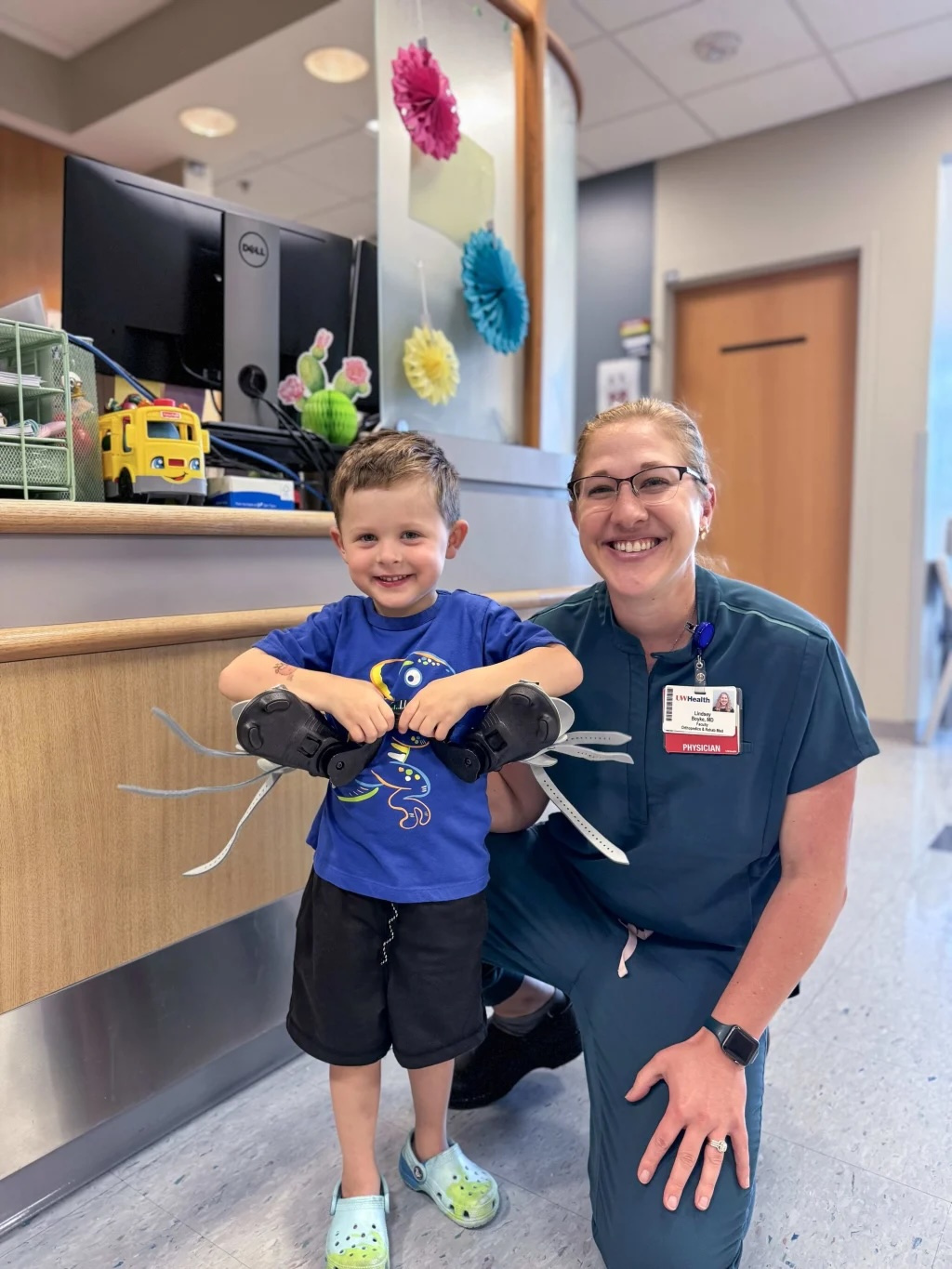
James Van Hierden and Dr. Lindsey Boyke
Before most orthopedic surgeons embraced the Ponseti method, most children with clubfoot were treated with a far more invasive procedure that frequently led to recurrence, chronic pain and lifelong arthritis.
Over the past few decades, the Ponseti method has emerged as the gold standard for treating clubfoot.
Dr. Kenneth Noonan, one of Dr. Boyke’s UW Health Kids orthopedic colleagues, trained with the procedure’s namesake, Dr. Ignacio Ponseti, in the early 1990s at the University of Iowa. Another UW Health Kids orthopedic specialist, Dr. Blaise Nemeth, had the opportunity to meet and learn from Dr. Ponseti.
Today, the entire UW Health Kids orthopedic team is trained in the Ponseti method. James received care from all members of the team.
“We’re very lucky that our team has had so much first-hand exposure to Dr. Ponseti,” Dr. Boyke said. “Many of our newer faculty, including myself, learned the Ponseti method from Dr. Noonan and Dr. Nemeth.”
.
.
James thrives physically after treatment
Today, James is thriving with no restrictions on his activities.
“He’s always been surprisingly strong, even as a baby,” Michael said. “He hit milestones early, walking and running, and just kept going from there.
“Honestly, that’s meant a lot to us because we know what he might have faced without treatment. Seeing him thrive physically has been incredible.”
Both of James’ parents are health care professionals. Their experience has provided them a unique appreciation for the care their son received from UW Health Kids.
“Health care is navigating some significant challenges right now, and as clinicians and now parents, we’ve come to deeply value programs like this,” Michaela said.
“We hope to offer encouragement to other families, many of whom travel long distances for this kind of care. We always felt so well cared for and the team always made sure we had everything we needed to care for James.”
.
..
This story originally appeared on uwhealth.org.