
Eric Cotter, MD, receives Freedom of Movement Award for Research to Improve Outcomes after Reverse Shoulder Replacement
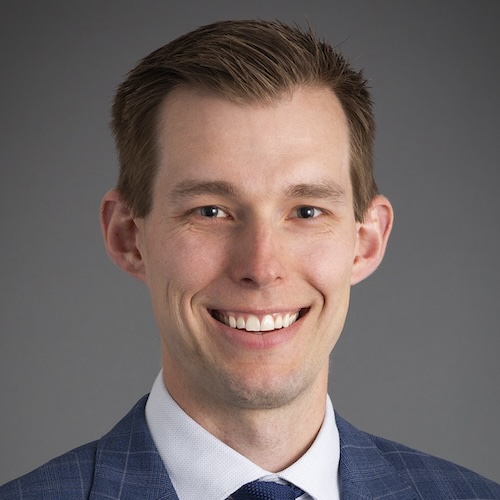
The UW Department of Orthopedics and Rehabilitation named orthopedic surgeon and assistant professor Eric Cotter, MD, a recipient of the 2026 Freedom of Movement (FOM) Award. Dr. Cotter’s FOM grant will support an innovative research project focused on improving outcomes after reverse total shoulder arthroplasty. The project, titled “Soft Tissue Tensioning in the Setting of Inlay, Lateralized Designed Reverse Total Shoulder Arthroplasty: A Cadaveric Study,” seeks to better understand how soft-tissue tension affects shoulder function following this commonly performed procedure.
Reverse total shoulder arthroplasty is now the most frequently performed type of shoulder replacement worldwide. Unlike a native shoulder joint, a reverse implant alters the normal ball-and-socket joint orientation, leading to changes in muscle mechanics and soft-tissue tension. While this approach has expanded surgical options for patients with complex shoulder conditions, debate continues surrounding how best to position implants and balance soft tissues to achieve optimal function.
Dr. Cotter’s study aims to define the ideal tension to apply during reverse shoulder replacement and how that tension affects surrounding structures. A novel aspect of the study is the use of a handheld tensiometer – a tool developed by co-investigator Josh Roth, PhD – to directly measure soft tissue forces within the shoulder during implantation. The project also incorporates a muscle–sparing surgical technique, visual markers to assess strain on the acromion as a surrogate for deltoid tension, and dynamic ultrasound imaging to evaluate shoulder joint stability.
The research team will conduct a cadaveric study of 20 shoulders, first simulating a standard clinical shoulder examination using ultrasound to establish baseline, native joint laxity. Reverse shoulder replacements will then be performed while systematically varying the thickness of the polyethylene component to incrementally increase soft-tissue tension. The team will collect measurements to assess how these changes influence acromial strain and tension within the conjoint tendon.
“This work,” says Dr. Cotter, “is one small step toward better understanding how tight we should be putting in these implants and if we can use a tensiometer for real-time feedback of soft tissue tension. This improved soft tissue balancing should lead to better long-term functional outcomes.”
Support from the Freedom of Movement Award enables this early phase of what Dr. Cotter hopes will be a larger research effort – one that has the potential to refine surgical decision-making in reverse shoulder arthroplasty in a way that optimizes postoperative range of motion for these surgical patients.
In addition to Drs. Cotter and Roth, Kyle Wagner, MD, Lauren Summers, MD, Andrew Sheean, MD, and Herman Feller, PhD, are co-researchers on the project. Pilot work is already underway, and the team anticipates completing the study by December 2026.