News & Events

See All News and Events

After 32 years, David Bernhardt will step away from the wide world of sports medicine to retire
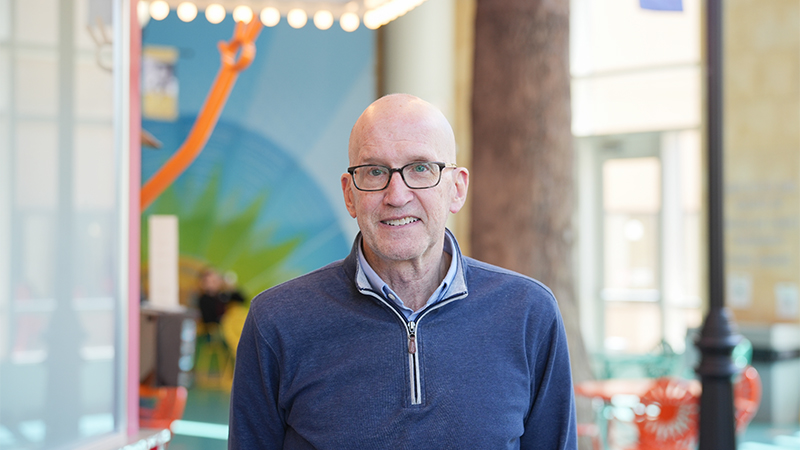


Your “dream job”? Many people hold that in mind and then try to find one as close as possible to it. David Bernhardt, MD, professor in the UW Departments of Orthopedics and Rehabilitation and Pediatrics, is one of those extraordinarily rare few who found his on the first try. Bernhardt specializes in primary care sports medicine and is the director of the Primary Care Sports Medicine Fellowship. He is a team physician for the University of Wisconsin Athletics Department, providing medical coverage for Badger men’s basketball and women’s volleyball, as well as for men’s and women’s cross country and track. And now, after 32 years doing the work he has loved, Bernhardt will step away into a deserved retirement on June 30.

A Madison native, Bernhardt decided in high school that he wanted to be a physician. “I kind of always knew I wanted to be a physician,” he said, “because my dad was a physician, and I admired what he did for patients. So I followed that path to become one.” Bernhardt also knew at that time that he wanted to be a sports medicine doctor.

While attending the then University of Wisconsin Medical School, he almost made a detour. In rotations, he found that he just did not enjoy orthopedic surgery, and at that time, that was the route many people took into sports medicine. “There were lifestyle reasons,” Bernhardt explained, “but the biggest reason was that the patients are so often asleep, and I enjoyed interacting with patients and caring for them in clinic. However, my very next rotation was pediatrics, which I loved.”

Serendipitously, he learned that Greg Landry was in the Department of Pediatrics. He was a general pediatrician primary care sports medicine doctor and the head team physician for UW athletics. “He had what I would call a dream job,” Bernhardt recalled.

“Right place, right time” magic manifested for Bernhardt when Landry offered him the opportunity to become the third-ever fellow for the Nathan Smith Postgraduate Sports and Adolescent Medicine Fellowship, which allowed him to train in primary care sports medicine at the University of Wisconsin. “And then he hired me into my dream job,” Bernhardt said.

Bernhardt’s patients include many outside UW athletics because of his three different hats of clinical practice. He is a general pediatrician at the UW Health clinic at 20 S. Park, where he sees patients from newborn to around 23 years of age. There, he addresses all the problems typically seen in pediatrics. He wears a second hat as the team physician for UW athletics, and his third practice is his job in primary care sports medicine, where he cares for young and older athletes.

“These patients are in high school, in college sports, and the occasional professional athlete,” he explained. “I also take care of the LOVB Madison, the professional volleyball team. And I take care of the typical recreational athlete and the old person who has arthritis.”

One thing Bernhardt always promotes to athletes and non-athletes alike is exercise. “We’ve had a mantra, first promoted by the American College of Sports Medicine, that exercise is medicine,” he said, “which means we should actually treat every patient as an athlete — trying to promote exercise as a part of a treatment plan.” Related to that, he uses exercise as treatment for kids he sees in his pediatric practice who have anxiety or depression. “I really try to emphasize that it’s important that they get out and move,” he said. “It doesn’t matter what they do — Frisbee, hiking, bike rides — I want them moving every day.”

After 32 years, David Bernhardt still loves his work, but he’s ready to try something new. He will retire on June 30.

Five Questions for David Bernhardt

How has your career surprised you, compared to how you had expected it to develop when you began?

I wanted to be a physician and wanted to go into sports medicine. The surprise was that I really loved my pediatrics rotation. I loved the residents I was working with, I loved the faculty who were teaching — the residents and the faculty wanted to teach, they respected my opinion. They made me feel that I was an important contributor to their team, so right away I just loved the whole pediatric part of medical school and medical education. The further surprise was that Greg Landry was in the Department of Pediatrics He offered me the sports medicine fellowship and eventually, my dream job. It was what I had expected to do, but via a different path.

What do you consider to be your biggest achievement?

I think that I’m a better doctor now than when I started, which is likely related to professional development in my wanting to learn the human aspects of being the best physician — as much or more so than knowing the science. I don’t think you get the training in medical school about how to be as compassionate and curious as you really need to be. In school, you learn to gather information, you learn how to do a physical exam, develop a differential diagnosis, but I think you miss the human part of being a doctor. So, I feel that my development there is my biggest achievement.

What has been your largest obstacle to overcome?

The constant tug of the job and wanting to do more for our patients, at the same time knowing our limits related to time and resources, as well as the taxing nature of our job in so many parts of our own lives.

What advice would you offer to new physicians just starting out?

I would stress the importance of work-life balance and making your own wellness and your own family a priority. I would also suggest continuing to expand your craft as a physician, thinking of yourself as a compassionate caretaker, good listener. And be curious: have a conversation with your patients similar to meeting a person at a coffeeshop or the terrace rather than just trying to get information doing a physical and telling them what to do.

Do you have specific plans for your retirement?

I’ll figure it out as I go: some mix of volunteer work, learning new things, travel, exercise, and seeing more of my kids, who live in Colorado.


This story originally appeared at pediatrics.wisc.edu.

Photo by Kate Feldt/Department of Pediatrics
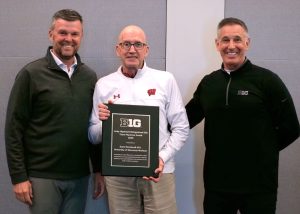
David Bernhardt, MD, named Big Ten Team Physician of the Year


We are proud to share that David Bernhardt, MD, has been named the recipient of the 2026 Andy Hipskind Distinguished Big Ten Team Physician Award, one of the Big Ten Conference’s highest honors in athletic medicine.

The award recognizes outstanding leadership, service, and dedication to student-athlete health across the conference. Dr. Bernhardt has served Wisconsin Athletics for more than 31 years as a team physician, educator, and mentor, earning widespread respect for his compassionate care, thoughtful leadership, and unwavering commitment to putting student-athletes first.

In addition to his work with Wisconsin Athletics, Dr. Bernhardt has made a lasting impact through his roles as a professor in the UW Departments of Orthopedics and Rehabilitation and Pediatrics, and as co-director of the Primary Care Sports Medicine Fellowship, helping to train the next generation of sports medicine professionals.

As he prepares to retire in June 2026, this recognition celebrates a remarkable career devoted to excellence in patient care, education and mentorship, and advocacy for student-athlete well-being.

Read more about Dr. Bernhardt here.

Orthopedic Surgery Residency Program Expands with Complement Increase


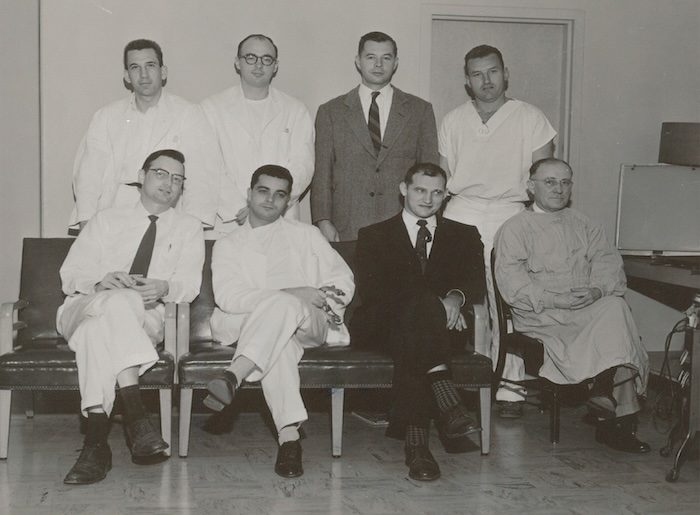
We’ve come a long way from only four total orthopedic surgery residents (pictured here with faculty in 1954).

The UW Department of Orthopedics and Rehabilitation is pleased to announce an expansion of its Orthopedic Surgery Residency Program, increasing the number of residents per class from six to seven, or from 30 to 35 total trainees over the next five years. This strategic growth reflects the department’s continued commitment to excellence in surgical education, clinical care, and academic scholarship, while responding to the evolving needs of patients and the orthopedic workforce.

While further strengthening the program’s robust training environment, this complement increase will help ensure continued excellence in patient care while preparing the next generation of orthopedic surgeons to meet the demands of modern practice.

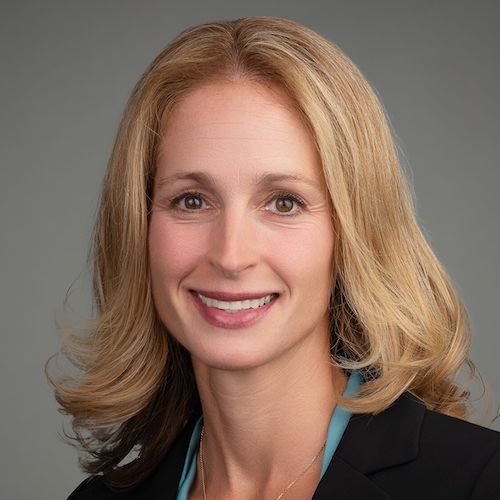
Kathryn Williams, MD
Orthopedic Surgery Residency Program Director


“The program leadership team and all of our faculty are so excited to have the opportunity to train even more residents, many of whom stay in the state of Wisconsin. We’re grateful that our department and our institution have grown enough to allow us this opportunity to maintain an excellent training experience.”


The Orthopedic Surgery Residency Program at UW-Madison is nationally recognized for its comprehensive training, dedicated faculty, and strong emphasis on academic inquiry and innovation. The department looks forward to welcoming future residents into this expanded program and continuing its tradition of excellence in education, service, and discovery.


Your support helps advance the exceptional education and training led by our outstanding faculty. We invite alumni and friends of the department to make a gift to the Orthopedic Surgery Education Fund
.

Freedom of Movement Awardee Andrew Watson, MD, aims to Improve Injury Prevention in Young Athletes


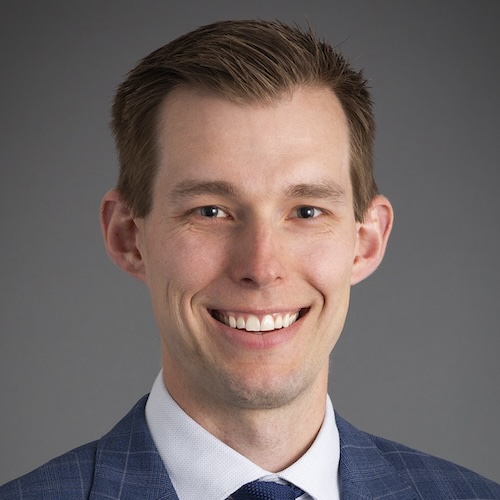
Andrew Watson, MD, associate professor in the UW Department of Orthopedics and Rehabilitation and director of the UW Human Performance Lab, has received a 2026 Freedom of Movement (FOM) Award in support of his research project, “The Interaction of Surface Type and Heat Stress to Influence Musculoskeletal Injury and Concussion Risk in Youth Athletes.” The award provides internal funding for a large-scale, data-driven study aimed at reducing injury risk in youth sports through evidence-based match scheduling.

Dr. Watson’s project addresses a critical gap in youth athletics. Although the risks associated with heat, playing surfaces, and competition demands are increasingly recognized, there is currently no evidence-based framework to guide match scheduling in ways that protect young athletes. This study will be among the first to prospectively combine real-world injury surveillance with detailed weather and playing surface data from elite youth soccer events across the United States, examining how heat stress, surface type, age, gender, and time of day interact to influence musculoskeletal injury and concussion risk.

A key strength of the project is its scale and real-world setting, made possible through a collaboration with the Elite Clubs National League (ECNL), the nation’s premier youth soccer development and competition platform, and the ECNL’s Center for Athlete Health and Performance. Dr. Watson’s lab has partnered with the ECNL for several years on initiatives related to athlete well-being, including mental health and injury prevention.

“Our collaboration with the ECNL,” said Dr. Watson, “has resulted in a fantastic opportunity to generate specific evidence that can translate into real-world interventions to benefit young athletes. This project builds on that relationship by advancing our understanding of how environmental factors influence injury risk and helping to develop a truly innovative approach to match scheduling that optimizes player health and safety.”

For this study, the ECNL is providing access to national injury surveillance data and match scheduling information. Certified athletic trainers at more than 40 ECNL national events will collect detailed injury information, allowing the research team to calculate precise injury rates across different age groups, genders, and playing surfaces. Data will be collected from events totaling an estimated 400,000 to 500,000 player-hours, providing the statistical power needed to identify meaningful injury patterns and interactions among multiple risk factors.

Injury surveillance data will be paired with historical local weather data to calculate wet bulb globe temperature, a standard measure of heat stress. This integrated approach will enable a more nuanced understanding of how environmental conditions influence injury risk in youth athletes.

The potential impact of this work is substantial. By examining how environmental and structural factors intersect, the research aims to identify previously unmeasured injury risk patterns and translate findings into practical, scalable match scheduling strategies that better protect young athletes while preserving competitive integrity. These findings could ultimately serve as a model for injury prevention, not only in youth soccer, but across a wide range of youth sports nationwide.

Collaborators on this project include Jennifer Sanfilippo, PhD, assistant director of sports medicine within UW Athletics and coordinator of Badger Athletic Performance, Christian Lavers, MBA, JD, president and CEO of the ECNL, and Kristin Haraldsdottir, PhD, a research scientist within the UW Human Performance Lab. Together, the team brings expertise in athletic performance, sports administration, injury epidemiology, and applied research, ensuring the project’s findings will be both rigorous and impactful.

“We are truly grateful to the UW Department of Orthopedics and Rehabilitation for the support of this ongoing work,” said Dr. Watson.

Eric Cotter, MD, receives Freedom of Movement Award for Research to Improve Outcomes after Reverse Shoulder Replacement


The UW Department of Orthopedics and Rehabilitation named orthopedic surgeon and assistant professor Eric Cotter, MD, a recipient of the 2026 Freedom of Movement (FOM) Award. Dr. Cotter’s FOM grant will support an innovative research project focused on improving outcomes after reverse total shoulder arthroplasty. The project, titled “Soft Tissue Tensioning in the Setting of Inlay, Lateralized Designed Reverse Total Shoulder Arthroplasty: A Cadaveric Study,” seeks to better understand how soft-tissue tension affects shoulder function following this commonly performed procedure.

Reverse total shoulder arthroplasty is now the most frequently performed type of shoulder replacement worldwide. Unlike a native shoulder joint, a reverse implant alters the normal ball-and-socket joint orientation, leading to changes in muscle mechanics and soft-tissue tension. While this approach has expanded surgical options for patients with complex shoulder conditions, debate continues surrounding how best to position implants and balance soft tissues to achieve optimal function.

Dr. Cotter’s study aims to define the ideal tension to apply during reverse shoulder replacement and how that tension affects surrounding structures. A novel aspect of the study is the use of a handheld tensiometer – a tool developed by co-investigator Josh Roth, PhD – to directly measure soft tissue forces within the shoulder during implantation. The project also incorporates a muscle–sparing surgical technique, visual markers to assess strain on the acromion as a surrogate for deltoid tension, and dynamic ultrasound imaging to evaluate shoulder joint stability.

The research team will conduct a cadaveric study of 20 shoulders, first simulating a standard clinical shoulder examination using ultrasound to establish baseline, native joint laxity. Reverse shoulder replacements will then be performed while systematically varying the thickness of the polyethylene component to incrementally increase soft-tissue tension. The team will collect measurements to assess how these changes influence acromial strain and tension within the conjoint tendon.

“This work,” says Dr. Cotter, “is one small step toward better understanding how tight we should be putting in these implants and if we can use a tensiometer for real-time feedback of soft tissue tension. This improved soft tissue balancing should lead to better long-term functional outcomes.”

Support from the Freedom of Movement Award enables this early phase of what Dr. Cotter hopes will be a larger research effort – one that has the potential to refine surgical decision-making in reverse shoulder arthroplasty in a way that optimizes postoperative range of motion for these surgical patients.

In addition to Drs. Cotter and Roth, Kyle Wagner, MD, Lauren Summers, MD, Andrew Sheean, MD, and Herman Feller, PhD, are co-researchers on the project. Pilot work is already underway, and the team anticipates completing the study by December 2026.